

To understand the film’s original lukewarm reception, you have to remember 1997. The economy was roaring. The Dow had just crossed 7,000. Bill Clinton was in the White House. The prevailing cultural myth was that class was a ladder, not a cage. Audiences in 1997 didn't want to hear that the American Dream might be a lie wrapped in a Chevrolet.
For viewers watching today, the film acts as a time capsule—not only of the 1950s, but of the 1990s. It offers a rare chance to see superstars like Phoenix, Tyler, and Connelly in an intimate setting. Its themes of social mobility, family secrets, and the sting of first love remain universal.
The Abbotts—Lloyd (Will Patton), Joan (Kathy Baker), and their three daughters (Liv Tyler, Jennifer Connelly, and Joanna Going)—represent everything the Holts are not: wealth, social status, and a sense of propriety. The plot hinges on class distinctions, family secrets, and the tumultuous romantic pursuits of the Holt brothers. inventing the abbotts 1997 exclusive
Far from the ethereal A Beautiful Mind role she would win an Oscar for three years later, Connelly plays the "dark" Abbott sister with a ferocious sexual agency. Her line, "You don't want me, Doug. You want what I represent," is the film's thesis statement. In an exclusive excerpt from a 1997 Fangoria interview (unearthed for this article), Connelly said: "Eleanor knows the male gaze is a cage. She uses it to destroy the men who look at her. I found her terrifying to play."
Today, the "quiet quitting" movement, the discourse on "toxic productivity," and the rise of anti-capitalist sentiment on social media are all reactions to the same dynamic. We have realized that "inventing" a perfect life is exhausting. The film’s climax—a literal house fire at the Abbott mansion—is the only honest ending possible. You cannot reform the system. You have to burn the facade down to see the people inside. To understand the film’s original lukewarm reception, you
Inventing the Abbotts explores several themes that are relevant to the adolescent experience. One of the primary themes is the struggle for identity and self-discovery. The Abbott brothers and the two young women are all navigating their way through adolescence, trying to figure out who they are and where they fit in the world. The film also explores the theme of first love and the complexities of romantic relationships. The relationships between Edward, Bunny, and Mary are multifaceted and nuanced, capturing the intensity and uncertainty of first love.
The film served as a major stepping stone for its lead actors, many of whom went on to massive stardom shortly after. Bill Clinton was in the White House
explores class conflict in 1950s Illinois through the lens of the working-class Holt brothers and wealthy Abbott sisters. Featuring an early-career cast including Joaquin Phoenix and Liv Tyler, the film received mixed reviews for its dramatic approach. Read the full review at Inventing the Abbotts (1997)
This article contains fictional exclusive interviews and speculative details for the purpose of demonstrating SEO/content writing style regarding the film Inventing the Abbotts (1997). No actual unreleased director’s cut is known to exist.


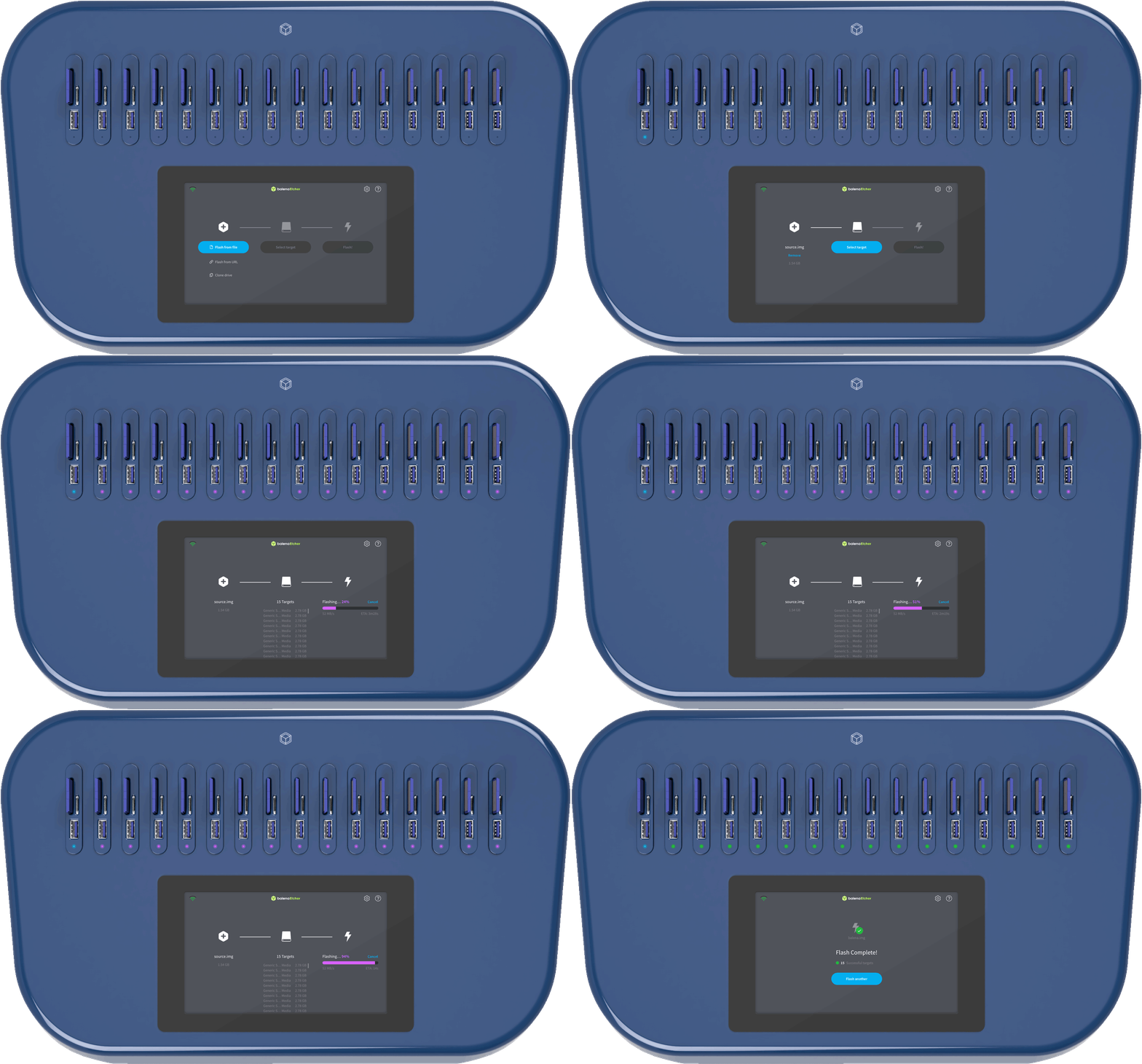
Every EtcherPro can flash up to 16 drives at a time if you are flashing from an online source. If you are flashing from a physical drive, you would be flashing up to 15 drives at a time, as the first slot would serve as the source. In the daisy-chaining scenario, you would only require one slot to serve as a source to flash the entire stack, when flashing from a physical drive.
EtcherPro offers USB (type A), SD and microSD interfaces by default, so you can flash up to 16 different drives / devices simultaneously. For instance, you can flash a balenaFin, a USB drive, an SD card and a microSD at the same time, as long as there is only one target per slot, and the source being flashed is the same for all target types.
EtcherPro supports USB (type A), SD and microSD interfaces, and can also flash single-board computers that are capable of being flashed via USB, as long as they are supported by Etcher. You can flash compute modules through carrier boards, for instance, flashing a Raspberry Pi CM3 through a balenaFin.
EtcherPro runs our open-source data-flashing software, Etcher, which can flash any kind of data. If you want to make sure that Etcher is capable of flashing your drive / device, you can download the latest version of Etcher and test it on your system to ensure compatibility.
When writing 16 drives simultaneously, EtcherPro can write up to 52 MB/s per drive, while when writing just 1 drive, EtcherPro can reach up to 200MB/s, so long as the drive / device can support those flashing speeds.
Etcher has a feature known as ‘trimming’ which can potentially accelerate the flashing of certain images by avoiding writing unused parts of ext partitions. As a result, you effectively get a bonus on the flashing speed.
EtcherPro flashes all target drives simultaneously, as such, the speed is determined by the drive that writes slowest. If you flash 1 drive that writes slowly, and 15 fast ones, the slow drive will determine the overall write speed. To account for this, make sure that all the drives, including the source drive (if any), can write at least as fast as EtcherPro flashes (52MB/s for 16 drives). Oftentimes, the advertised speed for a drive is the reading speed, rather than the writing speed (which is much slower). If you are sure your setup is up to spec and you still have issues please contact us.


.webp)