
What is Encryption?
With the increase in collaborative solutions moving to the cloud, there is an increase in cyber-attacks and data theft by accessing data through vulnerable points inside and out the network. How does encryption fit in?
With the increase in collaborative solutions moving to the cloud, there is an increase in cyber-attacks and data theft by accessing data through vulnerable points inside and out the network. How does encryption fit in?


SmartEncrypt works collaboratively with security and business continuity solutions to fill the gap and secure files containing valuable data.
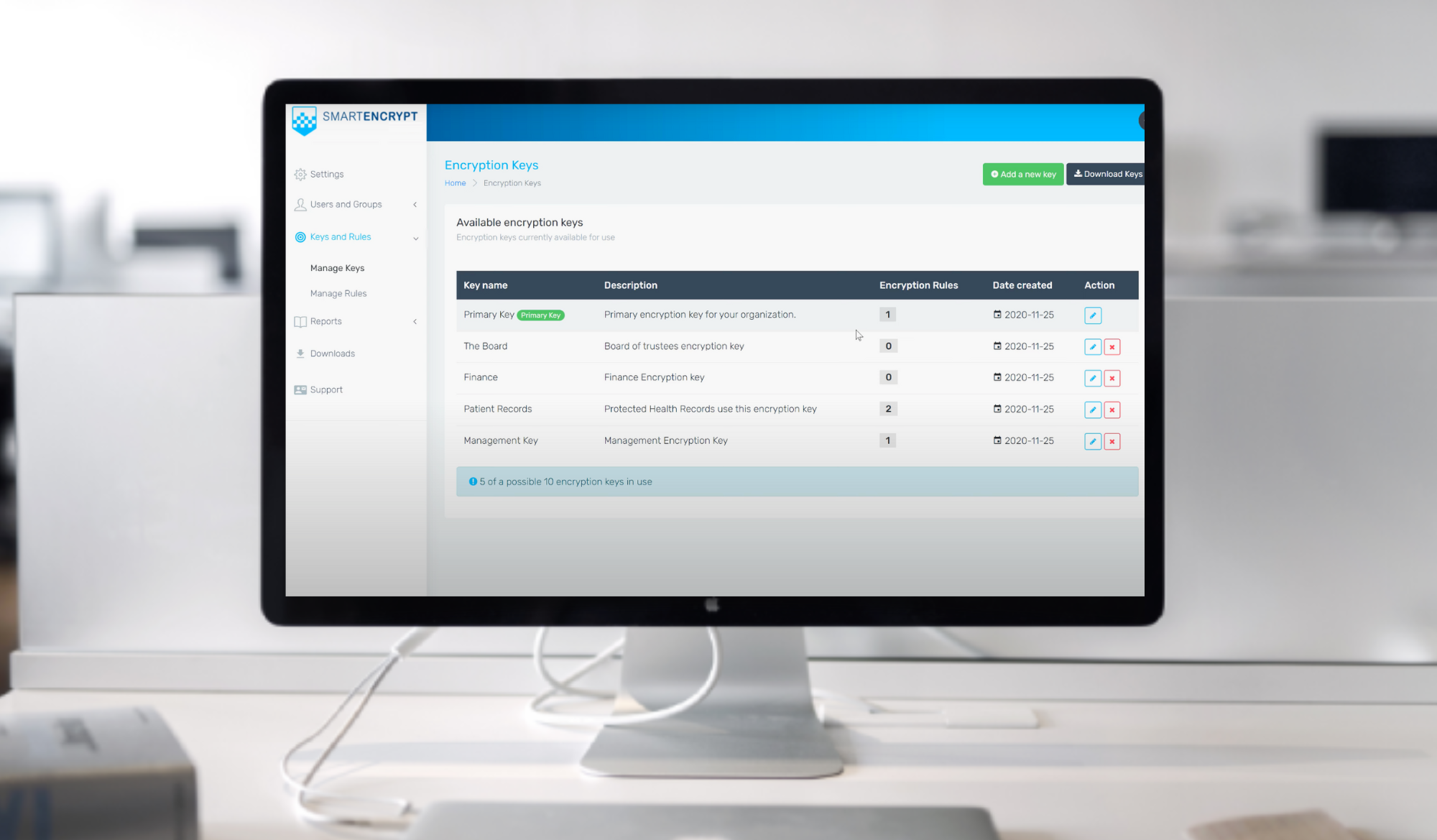
Although there are many encryption solutions currently in market, SmartEncrypt offers 5 key points of difference.
Files always remain encrypted regardless of where they travel, even after editing or moving out of an encrypted folder.
SmartEncrypt has no limitation on the size or types of files that can be encrypted. From the smallest text file to large specialist image files, all can be protected.
There are no changes to file types. Files can be opened and worked on as normal using File Explorer, or directly from within the file's associated app.
SmartEncrypt's centralised, web-based Management Console requires no hardware or software installation. And has no back-up or maintenance requirements or no ongoing associated server licensing costs.
SmartEncrypt works with files stored in both Microsoft SharePoint and OneDrive, including OneDrive’s Files On-Demand. Files remain encrypted both in and out of the cloud.
martEncrypt encodes and scrambles data so that it is unreadable and completely unusable, unless a user has the correct decryption key.
For small business with simple networks wanting control of who can access files e.g protect payroll and HR data from employees and IT
For Businesses environments requiring granular access controls e.g to restrict highly confidential files to access in the office firewall only or different teams or departments.
For large scale environments requiring granular access controls e.g to restrict highly confidential files to access in the office firewall only or different teams or departments.
Editors placed large black bars or digital pixelation over the contestants' pelvic regions and chests during the broadcast edit to enhance the illusion that the participants were completely naked. The Syndication and Home Video Myth
This escalation culminated in the "Psycho Fear Factor" stunt in 2005, which required contestants to strip naked in a public restaurant and submit to body piercing. While the episode was broadcast with heavy pixelation, the notion of an "uncensored" version became a topic of public fascination and legal scrutiny. This paper explores the mechanics of filming such a stunt, the immediate regulatory consequences, and the cultural implications of broadcasting nudity on network television.
that eventually led to the show's first cancellation, or are you more interested in the specific stunts that were actually banned from airing?
During the early 2000s, reality television operated like the Wild West. Networks pushed regulatory boundaries to capture a rapidly fragmenting audience. At the forefront of this shock-television movement was NBC’s hit show Fear Factor . Hosted by a pre-podcast-fame Joe Rogan, the series became a cultural phenomenon by forcing everyday contestants to face intense phobias for a $50,000 prize. Uncensored Public Nudity Episode Of Fear Factor
Because the show aired on a major network (NBC) during prime-time hours, it was strictly regulated by Federal Communications Commission (FCC) guidelines.
While there is no "uncensored" version of Fear Factor that aired on network television, the show did feature a famous segment titled "Public Nudity." This challenge appeared in , which originally aired on April 15, 2002. The "Public Nudity" Challenge
Understanding how NBC managed broadcast standards, what actually aired, and how internet culture transformed specific stunts into viral myths explains the reality behind this provocative television rumor. Broadcast Standards and the Reality of "Nudity" on NBC Editors placed large black bars or digital pixelation
Another reason the myth of the uncensored episode persists is the existence of "lost" or banned episodes of Fear Factor . The most famous among these is the infamous "Donkey Juice" episode from the 2012 revival series. In this episode, contestants were required to drink donkey semen and urine.
The "Uncensored Public Nudity Episode of Fear Factor " exists as a piece of . It is not a porno, nor is it a full-frontal spectacle. It is an uncomfortable, forgotten artifact of the reality TV arms race—a time when producers truly believed that the last taboo was the human body itself.
Ultimately, the "Naked Truth" episode remains a time capsule of early 2000s television—a period where networks were aggressively testing the boundaries of "decency" to compete with the rising popularity of internet shock sites. legal controversies This paper explores the mechanics of filming such
Television in the early 2000s was a wild west of reality programming. As networks pushed boundaries to capture ratings, competition shows became increasingly daring, psychological, and often, scandalous. Among these, NBC’s Fear Factor , hosted by Joe Rogan, stood out for placing contestants in high-stakes scenarios involving fears of heights, insects, and intense physical challenges.
[The Fear Factor Stage] │ ├──► Step 1: Strip completely naked in the backstage dressing area. ├──► Step 2: Walk down a runway into a room full of strangers. ├──► Step 3: Stand naked on a rotating pedestal for 2 minutes (hands on hips). └──► Rules: No covering up; strategic black bars applied only for broadcast. The Challenge Mechanics
This episode aired shortly after the Janet Jackson Super Bowl incident (2004), a period often called the "Decency Era." Networks were hyper-aware of FCC fines. The fact that Fear Factor managed to air a public nudity stunt without incurring a massive fine is often cited in media law discussions as an example of how context (framing nudity as a "challenge" rather than sexual) and technical censorship (pixelation) can navigate regulatory grey areas.
The social discomfort was palpable. While Fear Factor was designed to challenge contestants, this specific task blurred the line between physical discomfort and forced social humiliation.
If you want, I can:

“ SmartEncrypt is an amazing application that protects key data both internally at Virtual Graffiti and with our customer base. Whether the files are hosted in SharePoint, on a NAS, or locally, we know these are safe and intellectual property is protected. ”

“ SmartEncrypt makes it easy to offer my clients in the financial and professional services industry, the ability to protect their files and meet industry compliance regulations. The Protect & Share feature is ideal for sending contracts and other confidential files to their clients without risk and without their clients requiring a license to access the SmartEncrypt files. ”

“ Control access to personal and company data with trust that the keys are in my hands. SmartEncrypt solves the problem of encrypting data and keeping things simple. Gone are the days of spending hours to implement an encryption solution. SmartEncrypt is a simple turn key solution with options to secure different levels of access to files, including secure sharing of data. ”